

If you’ve spent any time driving through neighborhoods in Crownsville, Annapolis, or Columbia, you’ve likely noticed a shift in the local skyline. Roofs are looking deeper, more textured, and—frankly—more expensive.
When it comes time for a roof replacement, most Maryland homeowners find themselves at a crossroads: Traditional 3-Tab Shingles or Architectural (Dimensional) Shingles. While one saves you money today, the other is designed to protect your investment for decades.
Table of Contents
1. The Aesthetic Difference: Curb Appeal That Pops
The most immediate difference is purely visual.
- 3-Tab Shingles: These are flat and uniform. They consist of a single layer of material cut into three equal "tabs." It’s a classic, clean look, but it lacks depth.
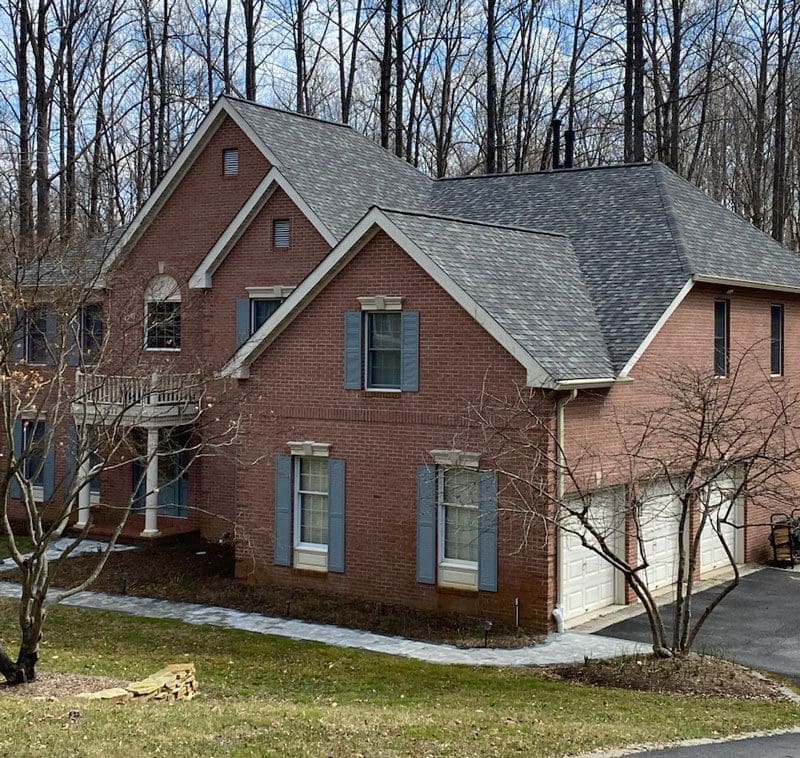
- Architectural Shingles: Often called "dimensional" shingles, these are engineered with multiple layers of asphalt laminated together. This creates a staggered, 3D effect that mimics the look of natural wood shake or slate.
In a real estate market as competitive as the Annapolis area, that "designer" look can be the difference between a house that looks "maintained" and one that looks "luxury."
2. Weathering the Maryland Elements: Wind & Humidity
In Maryland, our roofs have to survive everything from humid summer heatwaves to high-wind coastal storms.
- Wind Resistance: 3-tab shingles are lightweight and typically rated for winds up to 60–70 mph. In a severe Chesapeake storm, these are the shingles you’ll likely find in your yard the next morning.
- Durability: Architectural shingles are much heavier and thicker, boasting wind ratings up to 130 mph. Because they are roughly 50% heavier than 3-tab, they offer a much stronger defense against hail and falling debris.
3. The "Black Streak" Battle: Algae Resistance
Have you ever noticed those ugly black streaks on a neighbor's roof? That’s not dirt or soot—it’s Gloeocapsa magma, a hardy blue-green algae that thrives in Maryland’s high humidity.
Traditional 3-tab shingles are highly susceptible to this growth. However, most high-quality architectural shingles now come with built-in Algae Resistance (like GAF’s StainGuard Plus™).
4. ROI: Is the Extra Cost Worth It?
While architectural shingles generally cost about 20% to 25% more than 3-tab, the long-term Return on Investment (ROI) is significantly higher.
|
Feature |
3-Tab Shingles |
Architectural Shingles |
|
Typical Lifespan |
15–20 Years |
25–50 Years |
|
Warranty |
20–25 Years |
Limited Lifetime |
|
Property Value |
Standard |
High (Premium Feature) |
Common Roofing Questions: Maryland Homeowner Edition
The Verdict
If you are on a very tight budget or are repairing a rental property that you plan to sell immediately, 3-tab shingles provide a functional, low-cost solution.
However, for most homeowners in the Anne Arundel County area, architectural shingles are the superior choice. They offer double the lifespan, better storm protection, and the curb appeal that Maryland homes deserve.

Not sure which shingle matches your home’s color palette? Contact Colonial Roofing today for a free estimate and let us show you samples of the latest dimensional shingles in person!
 Skip to content